

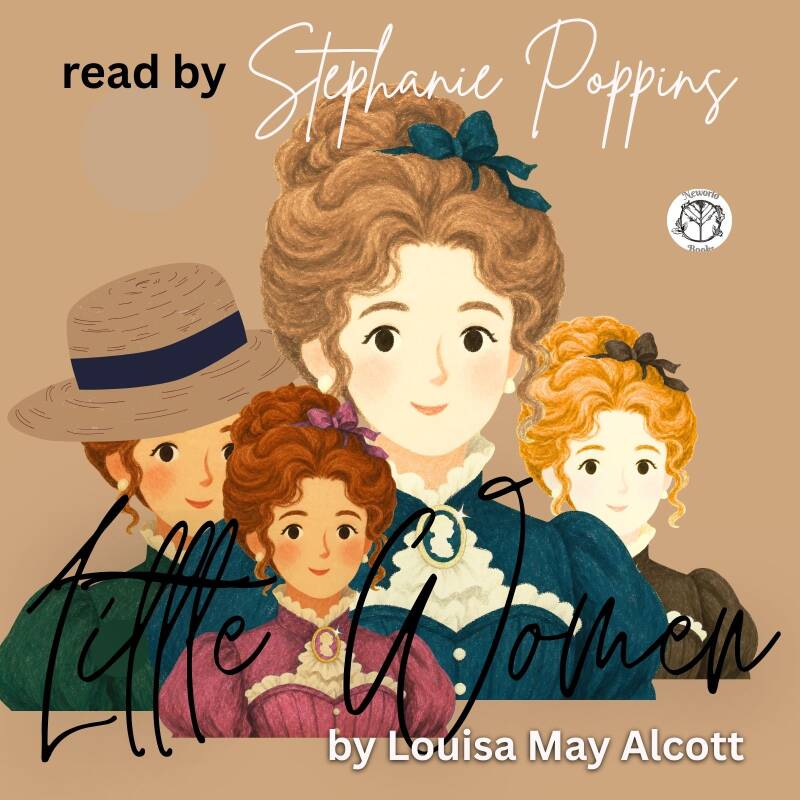
The Stoic Mother: What Marmee Can Teach Us About Stoic Stability in the Storm
She's not the loudest character in Little Women. She doesn't have the fiery ambition of Jo, the gentle artistry of Beth, the romantic longing of Meg, or the youthful vanity of Amy. And yet Mrs. March — "Marmee" — is the character the entire novel rests on. She's the healthy soil everything else grows out of. And she may be one of the most quietly Stoic figures in all of classic literature.
A Question About Motherhood
A listener recently wrote in with a question many mothers will recognise: I have an 11-year-old and a 7-year-old, and I struggle because they're so different to me. I want them to share my outlook, but I don't want to become a helicopter parent monitoring everything. I don't know how to come to terms with it.
It's a question about control — specifically, about how much of it we actually have over the people we love most. And Marmee, more than almost any character in literature, has already lived the answer.
Holding Everything Together
Marmee is mother to four daughters — Meg, Jo, Beth, and Amy — each wildly different from one another and from her. Her husband, a scholar and minister, has volunteered as an army chaplain during the Civil War, leaving her to manage the household virtually alone, on top of financial hardship caused by an unrepaid debt to friends.
She is never portrayed as achieving anything spectacular in the traditional sense. Her power is stability. She's present. She listens. Her daughters know they can bring her anything. And she holds that steadiness not because life is easy, but despite the fact that it constantly isn't.
This wasn't invention on Louisa May Alcott's part — it was memory. Alcott's own father, an enthusiastic but financially reckless transcendentalist philosopher, plunged his family into such severe poverty that they moved twenty times in twenty years. Alcott's mother became the de facto head of the household, and Louisa herself, watching her sister die of scarlet fever and her brother die in infancy, grew up carrying much of the family's financial burden. Little Women is, in many ways, autobiography wearing fiction's clothes.
The Dichotomy of Control, Applied to Parenting
Here's where Marmee becomes genuinely Stoic rather than simply "a good mother": she understands, instinctively, the difference between what she can and cannot control.
She cannot control how her daughters turn out. She cannot control how her choices are perceived, by her children or anyone else. She cannot control her husband's absence, the family's poverty, or the war raging around them. What she can control is her own behaviour — her commitment to virtue, her refusal to be swept into reactivity, her willingness to be pragmatic rather than paralysed by circumstance.
When she learns her husband has lent away money the family desperately needs, and then left to volunteer as an army medic, she doesn't collapse into despair. She gets practical. She finds ways for her daughters to earn small amounts of money. She acts.
That's the Stoic principle of courage in action: not the absence of fear, but the choice to hold steady and do something useful anyway.
Different Isn't a Failure
The character who tests Marmee most is Jo — headstrong, unconventional, cutting off her own hair, resisting every expectation of what a "good little girl" should be. Jo says of herself: "I'm always possessed to burst out with some particularly blunt speech or revolutionary sentiment before I know it. It's my doom and I can't help it."
Mrs March doesn't try to force Jo into her own shape. She sets boundaries. She models her example consistently. And then she lets go of the outcome, trusting that the example — not the enforcement — is what will eventually temper Jo's rashness. By the end of the story, we see a fully rounded Jo, not because Mrs March controlled her, but because she stayed present, stable, and true to her own virtue long enough for that example to take root.
This is precisely the answer to the listener's question: you cannot make your children into versions of yourself. What you can do is hold your own ground steadily enough that they have something solid to grow around.
Seneca's Warning Against Expectation
Seneca wrote that "the greatest obstacle to living is expectancy, which hangs upon tomorrow and wastes today." Mrs March never allows herself to live in the imagined future of who her daughters "should" become. She stays in the sowing, not the anticipated harvest. As she says herself:
"I know by experience how much genuine happiness can be had in a plain little house where the daily bread is earned, and some privations give sweetness to the few pleasures."
That's a woman who has released her grip on how things are supposed to look, and found peace in what's actually in front of her.
The Takeaway for Every Mother — and Every Daughter
Relationships, the Stoics remind us, are transactional in the truest sense: a meeting of differing needs that requires investment from both sides. We are only ever responsible for what we bring to that exchange — our patience, our presence, our consistency — never for how it's received or how the other person turns out. Whether you're the mother in this story or, like many listeners, relating it instead to your own mother, the lesson holds: hold your virtue daily, release your expectations of outcome, and trust that stability is its own quiet form of leadership.
Journal prompt: Where in your relationships — as a parent, or as a child — are you holding an expectation rather than practising acceptance? What would it look like to focus only on what you bring to the relationship today?
Listen to Little Women, Narrated by Stephanie Poppins
If Mrs March's steadiness has struck a chord, the full Little Women audiobook, narrated by Stephanie Poppins, is available now — bringing Alcott's semi-autobiographical world of the March sisters to life with warmth and nuance. Find it, along with the wider classic literature and Stoic-inspired audiobook collection, at Neworld Books, wherever you listen to audiobooks.
#FemaleStoicPodcast #LittleWomen #LouisaMayAlcott #MrsMarch #Marmee #StoicMother #Stoicism #StoicPhilosophy #DichotomyOfControl #NeworldBooks #StephaniePoppins #Audiobooks #WomenInLiterature #ClassicLiterature #Motherhood #Parenting #Seneca #MarcusAurelius #InnerPeace #BookLovers
Add comment
Comments